3D Parse
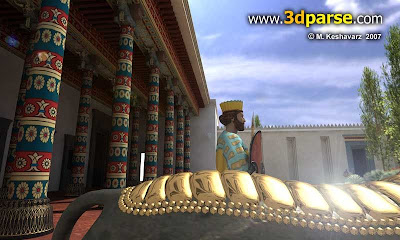
At the 3DParse you can find some beautiful images and movie clips of 3D reconstructed Persepolis done by Mr. Meysam Keshavarz. He's really done a magnificent job and deserves a thumb up or two ;-)
Persian Gallery of the Oriental Institute Museum

at the Persian Gallery of the Oriental Institute (of the University of Chicago) Museum
Arash-e Kamangir (Arash the Archer)

Arash was a mythological and legendary Persian archer who put his soul into his arrow to save his country.
The legend is that at the time of King Manuchehr the Righteous, a bloody war occurred between Iranians and Turanians. Afrasiab of Turan managed to surround the Iranian army hence forcing them to resign. Soon both sides agree to make peace but Turanians offered a strange sort of peace treaty that whatever land falls within the range of a bow-shot shall be returned to the Iranians, and the rest should then fall to the Turanians. Since there was no choice for Manuchehr, he agreed to it.
Arash the Archer was the only person capable of fulfilling this heavy burden. An angle (Amesha Spenta / Ameretat) known as Sepandarmaz (Spandarmaz /Esfandaramad) gave an special bow and arrow to him and there he went. On 13th day of Tir, Arash climbed the Alborz Mountains, stood on its highest peak Damavand, put his soul into his arrow and fired it towards Turan with all his might, then collapsed and died. The arrow traveled from dawn till noon over an unimaginably great distance till finally landed somewhere near Amu Darya (Oxus River) and marked the border between Iran and Turan. That was a joyful moment for the Iranians as they even gained more lands than before ;-) The event which was coincided with the pouring of the rain is ever since celebrated as Jashn-e Tiragan or Tirgan.
Arash the Archer sacrificed his life for his country and became a legend whose name and memory's still alive.
.
Khark Achaemenid Inscription Finally Vandalized >:-(
“Unknown people climbed the fence surrounding the cuneiform inscription and destroyed it with a sharp object, such that about 70 percent of the inscription has been seriously damaged,” Khark Deputy Governor Ali Jazebi told the Persian service of CHN on Saturday. “The nature of the damage indicates that it has been done deliberately,” he added. In late February, experts warned officials of the Cultural Heritage, Tourism and Handicrafts Organization about the threats posed by the forces of nature and vandals. Unfortunately, no appropriate security system was established to safeguard the cuneiform inscription, which has been etched on a piece of uneven rock encrusted with coral. The valuable relic was discovered during a road construction project on the island in the Persian Gulf in mid-November 2007. The rock, measuring 85x116cm, has become detached from its original terrain. The project was halted for a time because the rock prevented the project managers from continuing their work and finally they were forced to change the route. Shortly after its discovery, the inscription was deciphered by Rasul Bashshash, an expert at the Archaeological Research Center of Iran (ARCI). He made the following translation: “(This) land was a dry area with no water; (I) brought happiness and welfare, Bahana… water wells.” Experts had previously said that the inscription was important since it was another piece of evidence that confirms the word Persian for the Persian Gulf. The discovery of the inscription sparked a media frenzy in the Arab countries of the Persian Gulf, where efforts were made to cast doubt on its authenticity. The Bushehr Cultural Heritage, Tourism and Handicrafts Department (BCHTHD) announced on Saturday that they have filed a lawsuit against the suspected vandals. “There are several people suspected of (being responsible for) the damage to the inscription. We have sued them so the judicial investigation will begin as soon as possible,” BCHTHD Director Ahmad Dashti told CHN. But he refused to name the suspects. Dashti said that 10 to 15 percent of the inscription has been damaged, which is considerably different than the Khark deputy governor’s assessment. He rejected rumors that there was a connection between the vandalism and the disputes over the name of the Persian Gulf (Ah, so you mean this very Achaemenid inscription was chosen just randomly and out of mere luck by the so-called vandals and they took the trouble to destroy it only for fun and nothing else?!!!!! Some people believe that the BCHTHD is responsible for the problem, but Dashti rejected that view, saying, “The police are responsible for safeguarding the site, and they did their best.” “However, lack of an appropriate area to establish a guardhouse is one of our main problems here. The island is owned by the National Iranian Oil Company and they don’t provide even a span of earth to us to set up the base,” he explained. MMS/HG END MNA News Source : Mehr News Agency Image Source : Tabnak
TEHRAN, June 1 (MNA) -- The Achaemenid stone inscription of Khark Island was seriously damaged by vandals on Thursday night. 


Persepolis Recreated
"Persepolis Recreated" or "شکوه تخت جمشيد" in Persian is a great documentary where the ashes and ruins of Persepolis come to life once more with the help of computer technology as one of the magnificent and glorious cities and capitals of the ancient civilizations. Built by the order of Darius the great and completed by Xerxes the Great (not the strange looking guy you see in the ridiculous movie 300), Persepolis , the richest city under the sun, was very regretfully burnt to the ground in the rages of a Macedonian known to the world as Alexander.
 See Persepolis as it was 2500 years ago
Starting with the work of the German scholar Friedrich Krefter, who spend decades creating a model for a reconstructed Persepolis, film maker Farzin Rezaian and his team have produced Persepolis Recreated, a documentary that presents a virtual reconstruction of parts of the Persepolis palace complex. The film that includes commentaries by many of the leading authorities on Achaemenid architecture and history, brings to life and reveals the splendour of the Persepolitan palace complex before its destruction by Alexander. [1]
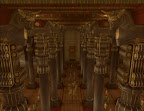
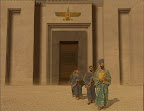

This is a Must See documentary for everybody interested in the ancient civilizations and their history (funnily or rather stupidly enough you cannot find a lot of info easily on the first important civilization of the world as if it is ignored for some unknown (?!!) reasons
 !!! ) , the reconstructions are done in such a great magnificent manner that you go wowing! Highly recommended.
Khayyam Commemoration Day
Today, May 17 (28 Ordibehesht) is Khayyam Commemoration Day in Iran.
Who is Hakim Omar-e-Khayyam
Ghiyās od-Dīn Abol-Fath Omār ibn Ebrāhīm Khayyām Neyshābūri (Persian: غیاث الدین ابو الفتح عمر بن ابراهیم خیام نیشابوری) or Hakim Omar Khayyám (Neyshābūr, Persia, May 18, 1048 – December 4, 1131) was a Persian poet, mathematician, philosopher and astronomer who lived in Persia.
He is best known for his poetry, and outside Iran, for the quatrains (Rubaiyats) in Rubaiyat of Omar Khayyam, popularized through Edward Fitzgerald's re-created translation. His substantial mathematical contributions include his Treatise on Demonstration of Problems of Algebra, which gives a geometric method for solving cubic equations by intersecting a hyperbola with a circle.
Persian Calendar 
On March 15, 1079, Sultan Malik Shah Saljuqi accepted this corrected calendar as the official Persian calendar. This calendar was known as Jalali calendar after the Sultan, and was in force across Greater Iran from the 11th to the 20th centuries. It is the basis of the Iranian calendar which is followed today in Iran and Afghanistan. While the Jalali calendar is more accurate than the Gregorian, it is based on actual solar transit, and requires an Ephemeris for calculating dates. The lengths of the months can vary between 29 and 32 days depending on the moment when the sun crossed into a new zodiacal area . This meant however, that seasonal errors were lower than in the Gregorian calendar (This calendric measurement has only an 1 hour error every 5,500 years, whereas the Gregorian Calendar, adopted in Europe four centuries later, has a 1 day error in every 3,330 years, but is easier to calculate).

The modern day Iranian calendar standardizes the month lengths based on a reform on March 31, 1925, under the early Pahlavi dynasty. The law said that the first day of the year should be the first day of spring in "the true solar year", "as it has been" and fixed the number of days in each month thus the first six months (Farvardin–Shahrivar) have 31 
Rubaiyat of Omar Khayyam
Omar Khayyám's poetic work has eclipsed his fame as a mathematician and scientist. He is believed to have written about a thousand four-line verses or quatrains (rubaai's). In the English-speaking world, he was introduced through the The Rubáiyát of Omar Khayyám translated into English by Edward Fitzgerald (1809-1883).Interesting to Know
- A lunar crater Omar Khayyam was named after him in 1970.
- A planetoid Omarkhayyam discovered by Soviet astronomer Lyudmila Zhuravlyova in 1980 is named after him.
- Omar's life is dramatized in the 1957 film Omar Khayyam starring Cornel Wilde, Debra Paget, Raymond Massey, Michael Rennie, and John Derek.
- Khayyám is quoted in Martin Luther King Jr.'s speech, Why I oppose the war in Vietnam. "It is time for all people of conscience to call upon America to come back home. Come home America. Omar Khayyám is right 'The moving finger writes and having writ, moves on.'"
- There are several references to Khayyam and his Rubaiyat in works of famous Argentinian writer Jorge Luis Borges
- A sparkling wine made in India, sometimes referred to as Indian Champagne is called Omar Khayyam.
- In Oscar Wilde's The Picture of Dorian Gray, Lord Henry refers to Omar Khayyam as the king of hedonism.
Cuneiform / خط میخی
Numbers in Old Persian

"I, Cyrus the King, an Achaemenid"

Sources:
[1] AncientScripts.com
[2] Circle of Ancient Iranian Studies (CAIS)
Vandals Smash Achaemenid Column Bases of Susa's Apadana Palace

LONDON, (CAIS) -- Column bases of the Achaemenid Apadana Palace of ancient Susa in Khuzestan Province have recently been demolished by vandals.
The palace’s remaining column bases have been broken into two pieces and the Old-Persian cuneiform inscriptions on the base have been obliterated, the Khuzestan Cultural Heritage Lovers Society (Tariana) spokesman Mojtaba Gahestuni told the Persian service of CHN on Sunday.
The stone inscriptions have been severed and scattered around the ancient archaeological site, he added.
“The reason for the destruction of the artefacts is not clear,” Gahestuni remarked, adding, “The incident probably results from the vandals’ ignorance of the historical significance of the relics.”
He went on to say that many problems are caused by the lack of protection and appropriate fencing around the site which covers about 360 hectares.
 “The Khuzestan Cultural Heritage, Tourism and Handicrafts Department (KCHTHD) undertook the installation of rods around the zone, but the measure was inadequate and has not prevented unauthorized people from entering the precinct,” Gahestuni explained.
According to Gahestuni, the use of concrete and iron rods for demarcation purposes has even led to some damage to the area.
The Apadana Palace is also being threatened by the construction of a preparatory school on its perimeter.
In early December, Tariana sent letters to the Islamic regime’s president Mahmud Ahmadinejad, asking him put a stop to the project – but the letter not so surprisingly was ignored.
The school building, which is to be four stories tall, will spoil the horizontal view from the palace ruins.
In addition, the historical metropolis of Susa, which has been inhabited for over 7000 years, is being spoilt by regime’s Municipality’s construction of a passenger bus terminal in the Shush city’s southern section.
 Experts have previously given warning of the chaotic situation at the site, pointing out that such disorder has facilitated the illegal activities of smugglers who have managed to carry out excavations in search of antiquities.
“Although some have claimed who try to be politically correct, that the vandalism was done out of ignorance, but everyone knows that it was done on purpose – the evidence is the razing of the Old-Persian cuneiform inscription from the base”, said an archaeologists with KCHTHD who wished to remain anonymous for his safety.
Same archaeologist added: “this crime against our national heritage either was done by the regime's elements, who are against anything Iranian in particular pre-Islamic, or the Arab settlers of the province, who are anti-Iranians and have always acted as a fifth column in our country, esp during the Iran-Iraq war – which the Islamic regime has increased their numbers since 1980s”.
Historical background:
Susa is one of the oldest-known settlements in the world, which possibly was founded about 4200 BCE, although the first traces of an inhabited village have been dated to ca. 7000 BCE.
In historic times, Susa was the primary capital of the Elamite Empire, and was known as Šušan and Šušun. The city appears in the Sumerian records of Enmerkar and the Lord of Aratta, and it is described as one of the places obedient to Inanna, patron deity of Uruk.
Cyrus the Great incorporated Susa to the Achaemnid Persian Empire in 538 BCE, and later under his son Cambyses II, the capital of the dynastic Empire was moved from Pasargadae to Susa. The city lost some of its importance when Alexander of Macedon sacked and looted the city in 331 BCE. After Alexander, Susa fell to his successors, the Seleucids. The city was finally liberated by the third Iranian dynasty, the Parthians who made Susa as one of their capitals alongside Ctesiphon.
Susa was destroyed at least four times in its’ history. The first was in 647 BCE, by the Assyrian king, Assurbanipal; the second destruction took place in 331BCE by Alexander; the third destruction was done in 338 CE, by the Moslem’s invading armies. Finally, in 1218, the city was completely destroyed by invading Mongols. The ancient city was gradually abandoned in the years that followed - and now its' remains witnesses the last blow to its existence by the Islamic regime and Arab settlers of the province.
© CAIS NEWS ( ARCHAEOLOGICAL & CULTURAL NEWS OF THE IRANIAN WORLD )
يكى از پايه ستونهاى كاخ آپادانا در شوش تخريب شد
 يكى از پايه ستونهاى كاخ آپادانا در محوطه شوش توسط افرادى ناشناس (!!!!؟؟؟!!!!) تخريب شد. اين پايه ستون تنها اثر كتيبه دار باقى مانده بود كه در اثر اين تخريب، ازبين رفت
  . ء
. ءشوش _ خبرگزارى ميراث فرهنگى _ گروه ميراث فرهنگى _ انجمن دوستداران ميراث فرهنگى، صنايع دستى و گردشگرى شوش از تخريب پايه ستون هاى كاخ آپادانى شوش درچند روز گذشته خبر داد.
"محمدرضا معتمدى"، كارشناس فرهنگ و زبانشناسى و مسئول انجمن دوستداران ميراث فرهنگى شوش در گفتگو با ميراث خبر از تخريب يكى از پايه ستون هاى كاخ آپادانا و پاك كردن كتيبه روى آن خبر داد.
به گفته وى كارشناسان ميراث فرهنگى در سال 79 براي جلوگيرى از تخريب بيشتر اين اثر آن را در دل خاك مدفون كردند اما دور بودن آن از ساير آثار و وسعت 400 هكتارى محوطه و محصور نبودن اين محوطه، امكان محافظت اصولى از آن را گرفته بود.
به گفته معتمدى تخريبهاى جدى از سال 85 به اين اثر وارد شده بود.
وي مهمترين راهكار براي جلوگيرى از اين تخريب ها را محصور كردن محوطه 400 هكتارى شوش توسط مسئولان سازمان ميراث فرهنگى استان و كشور دانست.
همچنين به گفته معمتدي بخشى از اين پايه ستون كنده و در محدودهاى دور از ستون افتاده بود كه توسط يکى از محافظان محوطه به كنار ستون برگردانده شد.
وى همچنين افزود:« وضعيت اين پايه ستون پيش از اين در سمينار "شوش و ميراث جهانى آن؛ چالشهاى کنونى و چشم انداز آينده" گزارش داده شده بود .»
وى همچنين تخريب گور اشكانى در محوطه شوش را در اثر سيلاب (!!!!!) تكذيب كرد و گفت:« زمانى كه خوزستان به دليل نبود بارندگي و خشكسالى تهديد مى شود چطور مىتوان علت تخريب اين گور را باران و سيلاب دانست ؟؟؟؟؟!!!!!! »
اگرچه سازمان ميراث فرهنگى و گردشگرى استان خوزستان براى نگهدارى اين محوطه تمام تلاش خود را به كاربسته است اما، وسعت400 هكتاري شوش نياز به امكانات و تجهيزات بيشترى دارد.
زهرا کشورى ...............
خبرگزارى ميراث فرهنگى
ء
Ferdowsi Commemoration Day

Today, May 14 (25 Ordibehesht) is Ferdowsi Commemoration Day in Iran.
Who is Ferdowsi?
Hakīm Abol-Qāsem Ferdowsī Tūsī (Persian: حکیم ابوالقاسم فردوسی توسی) or simply known as Ferdowsi, (935–1020) was a highly revered Persian poet who authored Shāhnāmeh (The Book of Kings) , a masterpiece and the national epic of Persian-speaking world as well as the entire Iranian realm.
Shahnameh
The Shāhnāmeh tells the mythical and historical past of Iran, beginning with the creation of the world and the introduction of the arts of civilization (fire, cooking, metallurgy, law) to the Aryans and ends with the sad Arab conquest of Persia. Also reflected in Shahnameh are Iran's cultural values, its ancient religions (Zoroastrianism) and its profound sense of nationhood no wonder this voluminous work is regarded by Persian speakers as a literary masterpiece.
Aside from its literary importance the Shâhnameh, written in almost pure Persian, has been pivotal for reviving the Persian language subsequent to the influence of arabic.
Ferdowsi is said to have died around 1020 in poverty at the age of 90, embittered by royal neglect, though fully confident of his work’s ultimate success and fame.
"Buildings of the city suffer deterioration
From the raindrop and the ray of sunlight."
"I founded a great palace of verse [The Shahnameh]
That is impervious to the wind and the rain"
"I shall not die, these seeds [of discourse] I've sown will save
My name and reputation from the grave,"
"And men of sense and wisdom will proclaim,
When I have gone, my praises and my fame."
One tradition claims Mahmud re-sent the amount promised to Ferdowsi’s village, but when the messengers reached his house, he had died a few hours earlier. The gift was then given to his daughter, since his son had died before his father at the age of 37. However, his daughter refused to receive the sum, thus making Ferdowsi’s Shahnameh immortal.
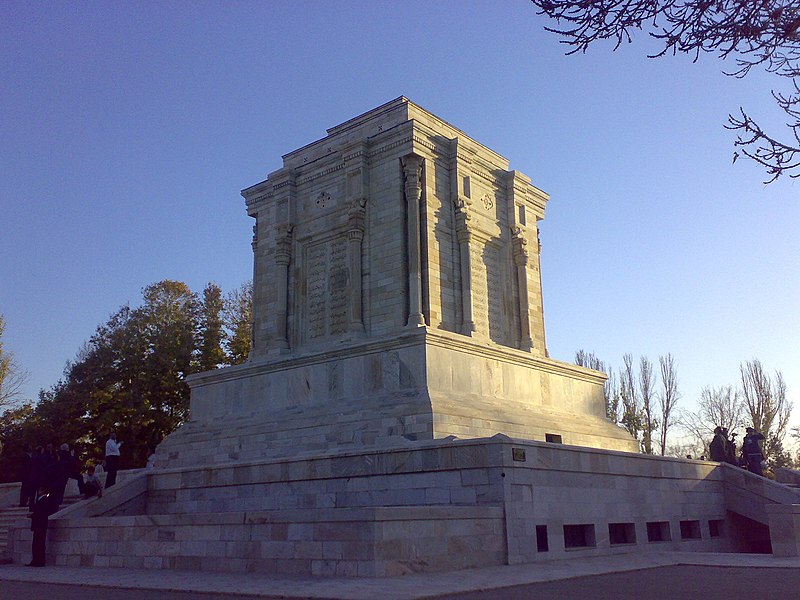
for more information please refer to Ferdowsi and Shahnameh articles on Wikipedia.


