Khayyam Commemoration Day
Today, May 17 (28 Ordibehesht) is Khayyam Commemoration Day in Iran.
Who is Hakim Omar-e-Khayyam
Ghiyās od-Dīn Abol-Fath Omār ibn Ebrāhīm Khayyām Neyshābūri (Persian: غیاث الدین ابو الفتح عمر بن ابراهیم خیام نیشابوری) or Hakim Omar Khayyám (Neyshābūr, Persia, May 18, 1048 – December 4, 1131) was a Persian poet, mathematician, philosopher and astronomer who lived in Persia.
He is best known for his poetry, and outside Iran, for the quatrains (Rubaiyats) in Rubaiyat of Omar Khayyam, popularized through Edward Fitzgerald's re-created translation. His substantial mathematical contributions include his Treatise on Demonstration of Problems of Algebra, which gives a geometric method for solving cubic equations by intersecting a hyperbola with a circle.
Persian Calendar 
On March 15, 1079, Sultan Malik Shah Saljuqi accepted this corrected calendar as the official Persian calendar. This calendar was known as Jalali calendar after the Sultan, and was in force across Greater Iran from the 11th to the 20th centuries. It is the basis of the Iranian calendar which is followed today in Iran and Afghanistan. While the Jalali calendar is more accurate than the Gregorian, it is based on actual solar transit, and requires an Ephemeris for calculating dates. The lengths of the months can vary between 29 and 32 days depending on the moment when the sun crossed into a new zodiacal area . This meant however, that seasonal errors were lower than in the Gregorian calendar (This calendric measurement has only an 1 hour error every 5,500 years, whereas the Gregorian Calendar, adopted in Europe four centuries later, has a 1 day error in every 3,330 years, but is easier to calculate).

The modern day Iranian calendar standardizes the month lengths based on a reform on March 31, 1925, under the early Pahlavi dynasty. The law said that the first day of the year should be the first day of spring in "the true solar year", "as it has been" and fixed the number of days in each month thus the first six months (Farvardin–Shahrivar) have 31 
Rubaiyat of Omar Khayyam
Omar Khayyám's poetic work has eclipsed his fame as a mathematician and scientist. He is believed to have written about a thousand four-line verses or quatrains (rubaai's). In the English-speaking world, he was introduced through the The Rubáiyát of Omar Khayyám translated into English by Edward Fitzgerald (1809-1883).Interesting to Know
- A lunar crater Omar Khayyam was named after him in 1970.
- A planetoid Omarkhayyam discovered by Soviet astronomer Lyudmila Zhuravlyova in 1980 is named after him.
- Omar's life is dramatized in the 1957 film Omar Khayyam starring Cornel Wilde, Debra Paget, Raymond Massey, Michael Rennie, and John Derek.
- Khayyám is quoted in Martin Luther King Jr.'s speech, Why I oppose the war in Vietnam. "It is time for all people of conscience to call upon America to come back home. Come home America. Omar Khayyám is right 'The moving finger writes and having writ, moves on.'"
- There are several references to Khayyam and his Rubaiyat in works of famous Argentinian writer Jorge Luis Borges
- A sparkling wine made in India, sometimes referred to as Indian Champagne is called Omar Khayyam.
- In Oscar Wilde's The Picture of Dorian Gray, Lord Henry refers to Omar Khayyam as the king of hedonism.
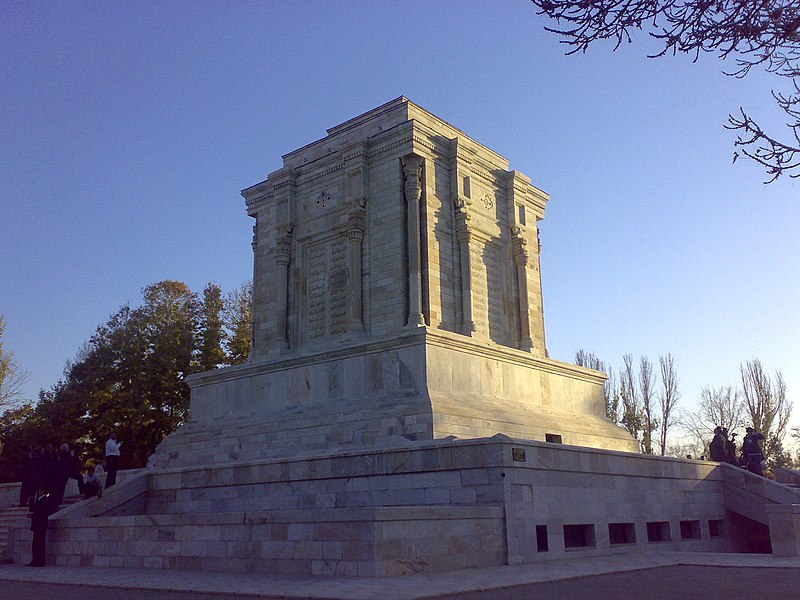
Ferdowsi Commemoration Day

Today, May 14 (25 Ordibehesht) is Ferdowsi Commemoration Day in Iran.
Who is Ferdowsi?
Hakīm Abol-Qāsem Ferdowsī Tūsī (Persian: حکیم ابوالقاسم فردوسی توسی) or simply known as Ferdowsi, (935–1020) was a highly revered Persian poet who authored Shāhnāmeh (The Book of Kings) , a masterpiece and the national epic of Persian-speaking world as well as the entire Iranian realm.
Shahnameh
The Shāhnāmeh tells the mythical and historical past of Iran, beginning with the creation of the world and the introduction of the arts of civilization (fire, cooking, metallurgy, law) to the Aryans and ends with the sad Arab conquest of Persia. Also reflected in Shahnameh are Iran's cultural values, its ancient religions (Zoroastrianism) and its profound sense of nationhood no wonder this voluminous work is regarded by Persian speakers as a literary masterpiece.
Aside from its literary importance the Shâhnameh, written in almost pure Persian, has been pivotal for reviving the Persian language subsequent to the influence of arabic.
Ferdowsi is said to have died around 1020 in poverty at the age of 90, embittered by royal neglect, though fully confident of his work’s ultimate success and fame.
"Buildings of the city suffer deterioration
From the raindrop and the ray of sunlight."
"I founded a great palace of verse [The Shahnameh]
That is impervious to the wind and the rain"
"I shall not die, these seeds [of discourse] I've sown will save
My name and reputation from the grave,"
"And men of sense and wisdom will proclaim,
When I have gone, my praises and my fame."
One tradition claims Mahmud re-sent the amount promised to Ferdowsi’s village, but when the messengers reached his house, he had died a few hours earlier. The gift was then given to his daughter, since his son had died before his father at the age of 37. However, his daughter refused to receive the sum, thus making Ferdowsi’s Shahnameh immortal.
for more information please refer to Ferdowsi and Shahnameh articles on Wikipedia.


